
Big Wild Goose Pagoda: A pagoda that encapsulates half of the glorious Tang Dynasty.
In Xi'an's skyline, there always stands a majestic, gray-blue figure. Unlike modern buildings, it is not ostentatious, but with a thousand years of tranquility, it bears the glory and spirit of a dynasty. This is the Big Wild Goose Pagoda, a brick pagoda that holds half of the history of the Tang Dynasty. Every brick is engraved with the marks of the era, and every eave echoes with the lingering sound of a thousand years.
This ancient pagoda, standing within the Great Ci'en Temple, originated from a persistent endeavor that traversed mountains and seas. In 652 AD, the monk Xuanzang petitioned Emperor Gaozong of Tang to construct this five-story "brick-outer, earthen-core" pagoda to house the 657 Buddhist scriptures, statues, and relics he brought back from India. It was named "Ci'en Temple Pagoda." Later, during the reign of Empress Wu Zetian, it was rebuilt to ten stories. After suffering damage from war and earthquakes, it was finally restored during the Ming Dynasty, becoming the seven-story pavilion-style brick pagoda we see today. This unique "Tang core, Ming exterior" style—the core of the pagoda from the Tang Dynasty encasing the brickwork from the Ming Dynasty, layer upon layer not only of bricks and stones but also of a thousand years of accumulated history.
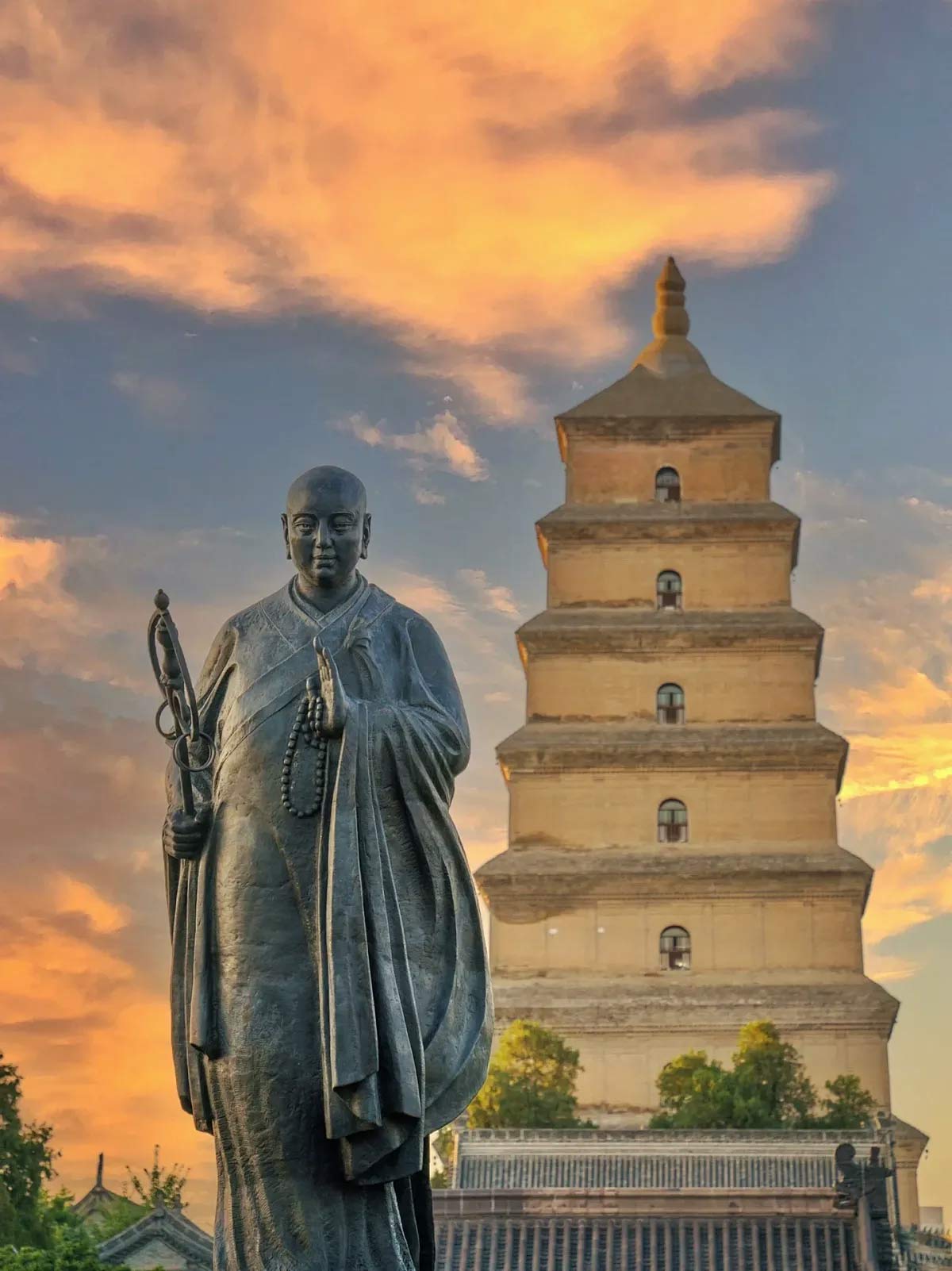
The Great Wild Goose Pagoda embodies the inclusiveness and openness of the Tang Dynasty. As a cultural landmark marking the starting point of the Silk Road, it witnessed the fusion and coexistence of Chinese and foreign civilizations. In its heyday, the Great Ci'en Temple was the highest-level Buddhist research center in the country. The monk Xuanzang spent nineteen years there translating Buddhist scriptures, tirelessly producing 75 works in 1335 volumes, deeply rooting Buddhist culture in the Central Plains. Indian monks frequently lectured at the temple, and scholars from the Western Regions traveled there, making the pagoda an important node for the exchange of knowledge between China and the West, silently speaking of the Tang Dynasty's spirit of "inclusiveness and thirst for knowledge." The "Two Saints and Three Perfections Stele" on either side of the south gate at the base, with inscriptions by Emperor Taizong, records by Emperor Gaozong, and calligraphy by Chu Suiliang, further integrates the emperor's emphasis, the scholar's talent, and the solemnity of Buddhism, becoming a national treasure.
If Buddhist scriptures and stone tablets are the "bones" of the Big Wild Goose Pagoda, then the inscriptions and elegant gatherings of literati are its "soul." During the prosperous Tang Dynasty, the Big Wild Goose Pagoda had long transcended the realm of Buddhist architecture, becoming a gathering place for scholars and literati. The "Wild Goose Pagoda Inscription" and "Wild Goose Pagoda Poetry Gathering" became cultural events that have been passed down through the ages. During the Shenlong era of Emperor Zhongzong of Tang, newly appointed Jinshi (successful candidates in the highest imperial examinations) would gather at the foot of the pagoda after the Qujiang Banquet to inscribe their names, symbolizing their success and fame. When Bai Juyi passed the imperial examination at the age of 27, he penned the ambitious line, "At the place where names are inscribed under the Ci'en Pagoda, I am the youngest among the seventeen," becoming a timeless tale. At the Wild Goose Pagoda Poetry Gathering in 752 AD, five poets, including Du Fu, Cen Shen, and Gao Shi, ascended the pagoda together, composing poems and essays. Cen Shen's line, "The pagoda's momentum surges forth, solitary and towering into the heavens," vividly captures the grandeur of the ancient pagoda; Du Fu, with "A lofty peak spans the azure sky, the fierce wind never ceases," uses the pagoda to express his feelings, conveying the literati's anxieties about their country and homeland. These verses make the Big Wild Goose Pagoda a witness to the spirit of the literati of the Tang Dynasty, and fill every level of the pagoda with poetry and passion.
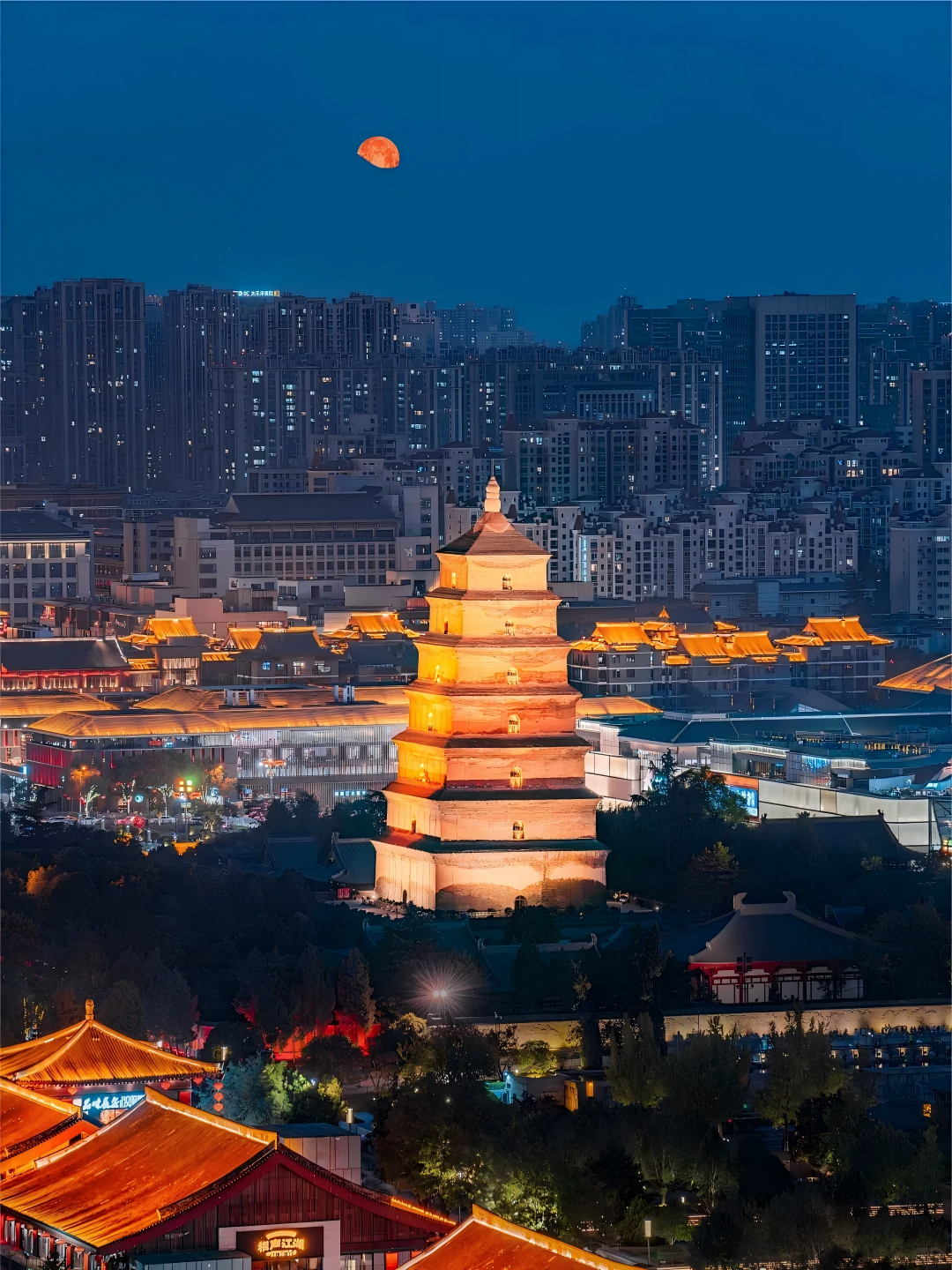
For millennia, the Big Wild Goose Pagoda has withstood the vicissitudes of time, yet it has always stood firm. It witnessed the prosperity and peace of the Tang Dynasty, and also the chaos of war; it saw camel caravans passing through Zhuque Street, and also the neon lights of the modern city. Today, as we step into the Da Ci'en Temple, pass through the courtyard shaded by ancient cypress trees, and look up at this 64.5-meter-high pagoda, the moss on the blue bricks exudes a tenacious vitality, and the copper bells on the eaves ring softly in the wind, as if still telling stories from a thousand years ago. Climbing the narrow spiral staircase, polished smooth by generations of visitors, each step feels like a step closer to the Tang Dynasty. Leaning on the railing and gazing into the distance, the ancient and modern features of Xi'an unfold before our eyes—the shimmering waters of Qujiang Pool, the winding Ming City Wall, the towering modern buildings, all intertwined with the tranquility of the ancient pagoda, forming a scroll painting spanning a thousand years.
Some say the Big Wild Goose Pagoda is the soul of Xi'an, and that's absolutely true. It's not just an architectural marvel, but also a symbol of the spirit of the Tang Dynasty. It embodies the perseverance and dedication of the monk Xuanzang, the talent and integrity of scholars and poets, the openness and inclusiveness of a dynasty, and the ordinary people's pursuit of beauty and faith. In 2014, the Big Wild Goose Pagoda was inscribed on the World Heritage List as part of the "Silk Roads: the Routes Network of Chang'an-Tianshan Corridor," transforming from a city landmark into a global symbol of cultural exchange and mutual learning between China and other countries.
Today, countless people come here every day, some to climb the tower for a panoramic view, some to pause and reflect, and some to take photos. They touch the thousand-year-old blue bricks, read the poems on the walls, and feel the lingering warmth of the Tang Dynasty. This tower is no longer just a cold pile of bricks and stones; it has warmth and a soul, witnessing the changing times and protecting the inheritance of culture.
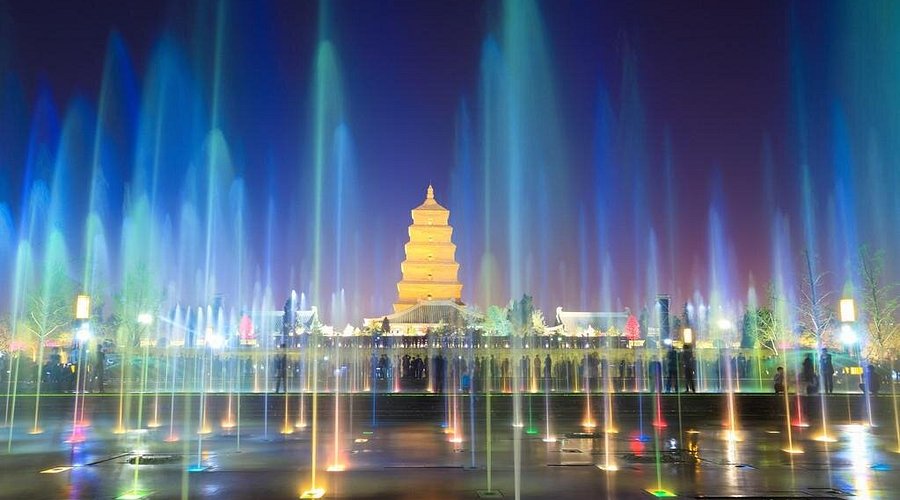
As the sun sets, its afterglow bathes the Big Wild Goose Pagoda in a golden glow, reflecting off the musical fountain in the North Square. Here, the moonlight of the Tang Dynasty meets the neon lights of modern times. This pagoda, bearing witness to half of the Tang Dynasty's history, also continues to tell a story belonging to the new era. It tells us that true civilization is never submerged by time; those who persevere and cherish, who embrace and strive, will ultimately transcend millennia, living on forever.